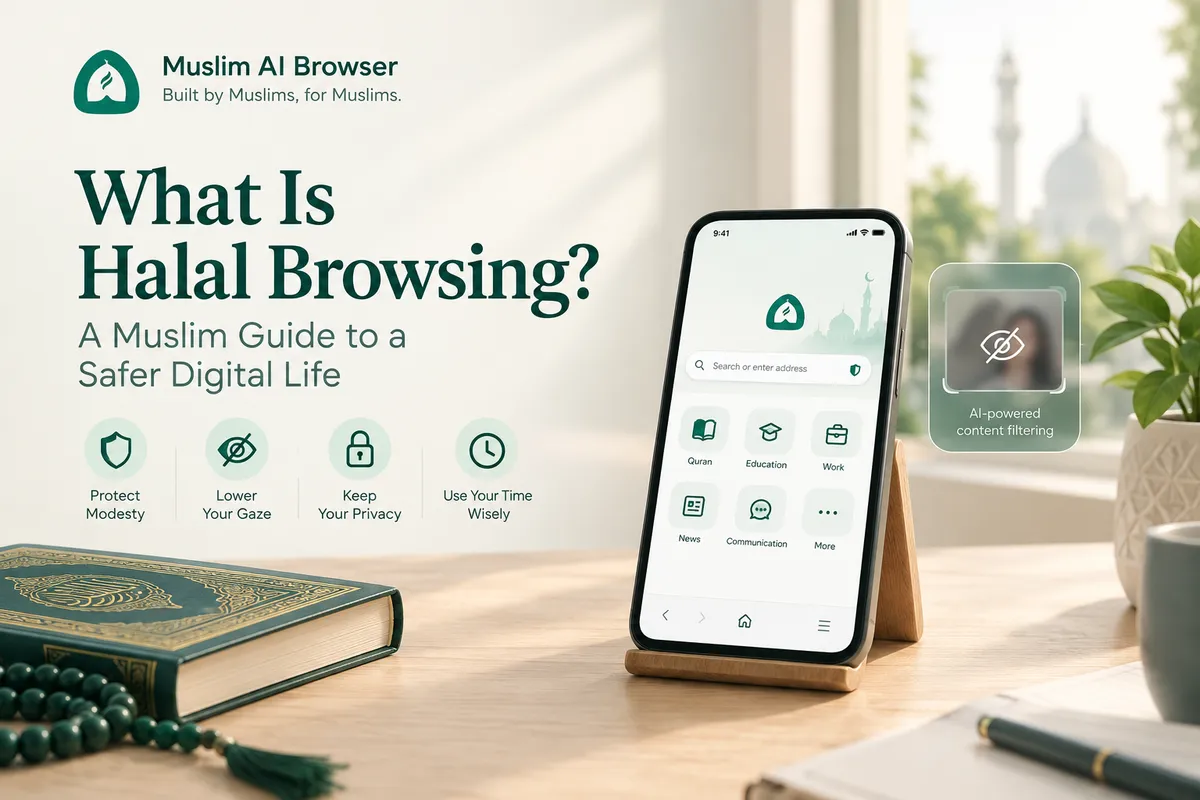
The internet has become part of almost everything we do.
We use it to study, work, communicate, shop, learn about Islam, watch lectures, read the Quran and stay connected with people around the world.
But the internet also brings something Muslims have to think seriously about: what we see, what we consume and how we spend our time online.
A simple search can lead to an unexpected image. A social media feed can suddenly show inappropriate content. A YouTube recommendation can lead to hours of short videos. Advertisements can appear that we never asked to see.
This raises an important question:
Can the way we browse the internet be aligned with Islamic values?
That is where the idea of halal browsing comes in.
Halal browsing is not about creating a completely separate internet for Muslims. It is about using the internet in a way that helps protect your faith, modesty, privacy, time and attention.
What Is Halal Browsing?
Halal browsing means using the internet in a way that is consistent with Islamic principles and personal responsibility.
It generally involves trying to:
- Avoid deliberately viewing prohibited or inappropriate content
- Lower the gaze when encountering inappropriate material
- Avoid websites and activities that are harmful or impermissible
- Protect personal privacy
- Reduce unnecessary distractions
- Use technology for beneficial purposes
- Create a healthier digital environment for yourself and your family
The term halal browsing does not mean that a particular browser can automatically determine everything that is halal or haram.
Rather, it describes an approach to using technology.
A halal browser or browsing tool can support that approach by reducing exposure to certain types of content and distractions.
Is Halal Browsing an Islamic Concept?
The specific phrase halal browsing is a modern term. The underlying principles, however, connect to established Islamic teachings about modesty, the gaze, privacy and responsible behavior.
Allah says in Surah An-Nur:
Tell the believing men to reduce [some] of their vision and guard their private parts. That is purer for them. Indeed, Allah is Acquainted with what they do.
The following verse gives corresponding guidance to believing women regarding the gaze and modesty.
This principle has clear relevance to the digital environment.
The screen may be different from the physical world, but the challenge of controlling what we intentionally look at remains.
The Prophet Muhammad ﷺ also instructed Jarir ibn Abdullah regarding an unexpected glance at a non-Mahram, telling him to turn his eyes away. This narration is recorded in Sahih Muslim 2159a.
This highlights an important distinction.
Islam does not expect a person to control every unexpected thing that appears before them. It teaches responsibility for how they respond.
That is particularly relevant online, where unexpected content can appear without warning.
Why Is Halal Browsing Important?
The modern internet is designed around attention.
Social media platforms recommend more content. Websites display advertisements. Video platforms automatically suggest another video. Short-form content makes it easy to keep scrolling without a clear stopping point.
This can create two different problems for Muslims.
The first is content exposure.
You may encounter inappropriate images, videos or advertisements even when you did not intentionally search for them.
The second is attention loss.
You may open your phone to answer one message and find yourself scrolling for 30 minutes.
Halal browsing tries to address both problems by making the digital environment more intentional.
The goal is not simply to block everything.
The goal is to make it easier to use technology for the reason you actually opened it.
What Does Halal Browsing Look Like?
Halal browsing can be very simple.
For one person, it might mean using the internet primarily for education, work and communication while avoiding inappropriate websites.
For another, it might mean using content filters to reduce exposure to explicit material.
For a parent, it might involve creating a safer browsing environment for children.
For someone struggling with social media, it might mean blocking Reels and Shorts to reduce unnecessary scrolling.
There is no single setup that works for everyone.
The important thing is intentionality.
Before opening a website or app, ask:
Why am I opening this?
And after using it, ask:
Did this help me, or did it simply consume my time?
Lowering Your Gaze Online
One of the biggest challenges of modern digital life is that inappropriate visual content can appear without being actively searched for.
A social media feed may contain images from accounts you do not follow.
A news website may display an advertisement.
A search result may contain an unexpected image.
A video recommendation may show something inappropriate in its thumbnail.
This makes digital gaze protection more difficult than simply deciding not to search for explicit content.
A practical approach is to combine personal discipline with environmental controls.
For example:
- Unfollow accounts that regularly post inappropriate content
- Use content filtering where available
- Avoid unnecessary browsing
- Turn off distracting recommendations where possible
- Leave pages when inappropriate content appears
- Use tools that can reduce unwanted visual exposure
Technology cannot replace self-control.
But technology can help create an environment where self-control becomes easier.
Halal Browsing and Digital Distractions
Not everything harmful online is necessarily explicit.
Time itself can become a problem.
You may intend to watch one educational video and end up watching twenty.
You may open Instagram to reply to a message and spend an hour scrolling.
You may start researching something important and become distracted by recommendations.
This is why halal digital living should also include responsible use of time.
A healthier digital environment should not only help you avoid harmful content. It should also help you stay focused on beneficial activities.
Features such as Reels and Shorts filtering can support this by reducing some of the mechanisms that encourage endless scrolling.
Privacy Is Part of a Healthier Digital Life
Halal browsing is also connected to privacy.
Your browsing activity can reveal a surprising amount about your interests, habits and behavior.
That makes privacy an important consideration when choosing digital tools.
Muslim AI Browser, for example, positions itself as a privacy-focused browser. Its privacy approach is designed to keep browsing information on the user's device, while its AI content filtering runs on-device rather than requiring images or videos to be sent to remote servers for the filtering process.
This matters because a privacy-focused approach can help minimize unnecessary collection of browsing information.
However, users should still read the privacy policies of the services they use and understand what information each service actually collects.
Can a Browser Make the Internet Completely Halal?
No.
This is one of the most important things to understand.
A browser can filter content.
It can block websites.
It can reduce advertisements and distractions.
It can blur certain images.
But it cannot control every decision a person makes.
No technology can guarantee that someone will never see inappropriate content or never make a wrong decision online.
AI filtering can also make mistakes. It may fail to identify some content or occasionally filter something that should not have been filtered.
That is why halal browsing should be understood as a combination of technology, personal discipline and Islamic awareness.
The technology can help.
The responsibility remains with the user.
How Technology Can Support Halal Browsing
Modern AI makes it possible to filter content directly on a user's device.
Muslim AI Browser uses on-device AI to detect and blur inappropriate visual content while browsing. This approach allows the filtering process to happen locally rather than requiring the visual content to be sent to remote servers for analysis.
The browser also includes features such as ad blocking, malicious-site protection, adult-content filtering, gambling-site filtering and controls for Reels, Shorts and sponsored content.
These features are designed to reduce exposure and distraction rather than promise a completely risk-free internet.
That distinction matters.
What Is Muslim AI Browser?
Muslim AI Browser is an Android browser built around Islamic values, privacy and content filtering.
Its core idea is straightforward: help Muslims navigate the internet while making it easier to protect modesty, privacy and attention.
One of its main features is AI Haram Blur, which uses AI to detect and blur inappropriate visual content in images and videos on the device.
The browser also provides several layers of filtering, including adult-content and gambling-site filtering, advertising controls, malicious-site protection and social-media distraction controls.
It is currently available for Android, with Android 7.0+ compatibility.
For desktop users, the related Porda AI product provides Haram Blur through desktop browser and Windows solutions. It should not be confused with Muslim AI Browser itself.
The larger idea is not that Muslims should stop using technology.
It is that technology can be designed around values that matter to its users.
7 Practical Tips for Halal Browsing
1. Know Why You Are Going Online
Before opening your browser, have a purpose.
Study. Work. Research. Communication. Beneficial entertainment.
A clear purpose makes unnecessary browsing easier to recognize.
2. Clean Your Digital Environment
Unfollow accounts that repeatedly expose you to inappropriate material.
Leave groups and pages that consistently create temptation or distraction.
Your feed is an environment. Treat it accordingly.
3. Use Content Filters
If a tool can reduce exposure to unwanted content, use it.
Content filtering is not a replacement for discipline, but it can provide another layer of protection.
4. Reduce Short-Form Distractions
If Reels and Shorts repeatedly consume your time, consider blocking or limiting them.
The goal is not to hate technology.
It is to stop technology from controlling your attention.
5. Protect Your Privacy
Review the permissions and privacy policies of your browsers and apps.
Ask what data is collected, where it is processed and whether you actually need to provide it.
6. Leave Inappropriate Content Quickly
Sometimes something inappropriate will still appear.
Do not stare.
Do not investigate.
Do not continue scrolling out of curiosity.
Turn away and move on.
7. Remember That Technology Is Only a Tool
A halal browser can support a halal digital lifestyle.
It cannot live that lifestyle for you.
Your choices still matter.
The Bigger Idea Behind Halal Browsing
The most important question may not be:
Which browser blocks the most content?
It may be:
What kind of digital environment helps me become the kind of Muslim I want to be?
Technology influences our habits.
The websites we visit influence what we see. The feeds we follow influence what repeatedly enters our minds. The notifications we allow influence where our attention goes.
That means digital discipline deserves the same kind of intentionality we apply to other parts of life.
Halal browsing is ultimately about bringing that intentionality to the internet.
It means using technology without allowing technology to dictate your values.
And when a tool can help reduce unwanted exposure, protect privacy or minimize distraction, it can become one useful part of that effort.
The goal is not a perfect internet. It is a more intentional one.