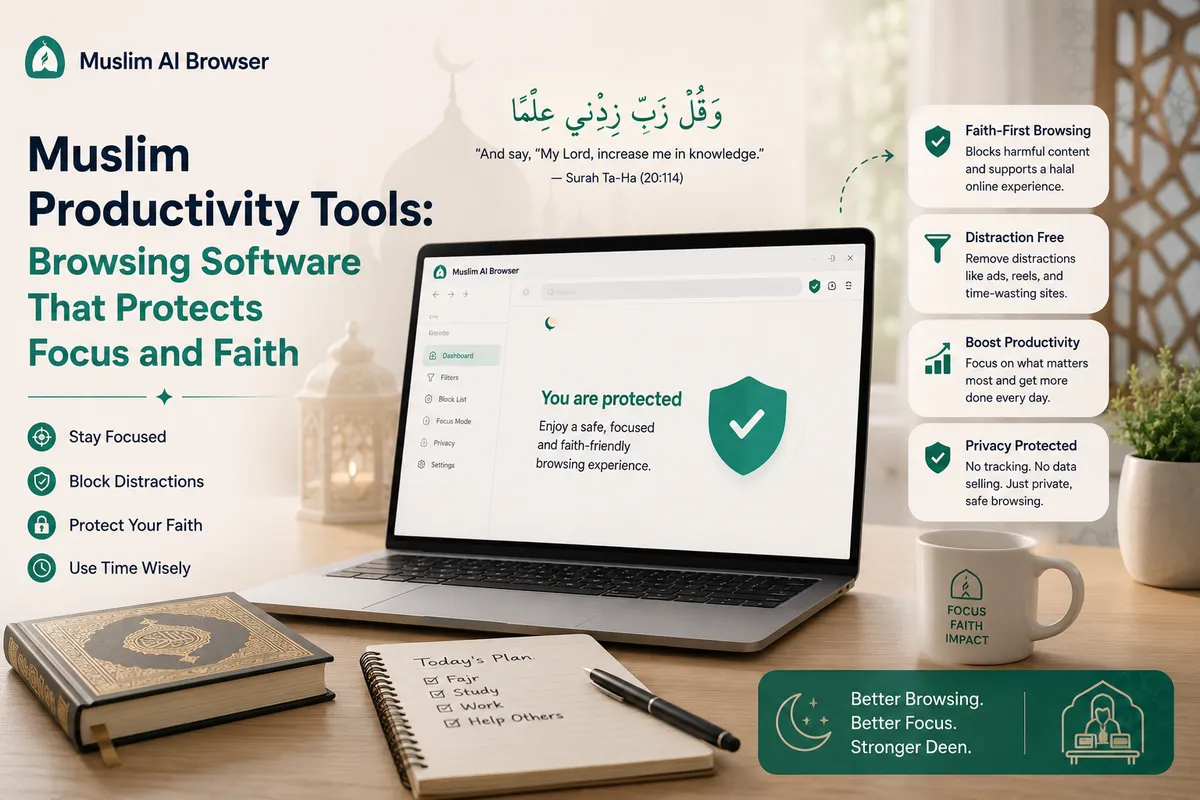
Muslim Productivity Tools: Browsing Software That Protects Focus and Faith
Most productivity advice focuses on to-do lists and time blocking. It rarely mentions the biggest daily drain for a lot of Muslims: the time and attention lost to feeds that were never built with focus, or faith, in mind.
That's where a specific category of Muslim productivity tools comes in — software designed not just to manage time, but to protect it from content and platforms engineered to consume as much of it as possible.
This guide covers what these tools actually do, and how they fit alongside more traditional productivity habits.
What Makes a Tool a "Muslim Productivity Tool"
Not every productivity app fits this category. A generic to-do list works the same for anyone. A Muslim productivity tool is built around a specific combination of goals: protecting time, focus, and Islamic values simultaneously.
That usually means addressing two connected problems:
- Distraction — algorithmic feeds, autoplay videos, and suggested content designed to maximize time spent, not time well spent.
- Content exposure — the same feeds often surface content that conflicts with Islamic guidance on modesty and the gaze.
Tools in this category, like Porda AI, are built to address both at once, rather than treating focus and values as separate problems requiring separate solutions.
Why Standard Productivity Tools Miss This Popular productivity tools — website blockers, time trackers, focus timers — are useful, but they weren't designed with Islamic priorities in mind.
A website blocker might stop you from opening Instagram for an hour, but it does nothing about what you see the moment that hour ends. A time tracker tells you how much time you spent scrolling, but not what you saw while doing it.
This matters because time and content are connected problems. Spending less time on distracting platforms helps, but so does changing what you see during the time you do spend there — which is where AI-based filtering fits in.
How AI Browsing Tools Support Productivity
Tools like Porda AI use computer vision, a form of AI trained to detect patterns like faces in images and video, to filter content in real time as it loads.
In productivity terms, this does two specific things:
- Reduces distraction volume. By stripping out algorithm-inserted suggested posts, sponsored content, and autoplay Reels, there's simply less content pulling your attention in the first place.
- Reduces cognitive and spiritual friction. Constantly encountering content that conflicts with your values takes a toll — not just on focus, but on the mental effort of managing that conflict repeatedly throughout the day.
Removing both sources of friction frees up attention for whatever you actually opened the browser to do.
Building a Practical Muslim Productivity Stack
1. Content filtering (Porda AI) Handles real-time face blurring, feed cleaning, and ad blocking, reducing both distraction and unintentional exposure.
2. Website or app blockers Restrict access to specific platforms during work, study, or prayer times.
3. A simple time-tracking habit Even a basic log of screen time by app highlights where attention is actually going, which is often surprising.
4. Structured prayer and break reminders Anchoring the day around prayer times naturally builds in regular breaks from screens.
5. An intentional "why" for each session Before opening a browser, a quick mental note of what you're there to do reduces aimless scrolling before it starts.
Practical Tips for Getting Started
- Start with content filtering first — it addresses the problem passively, without requiring constant willpower.
- Layer in time-based tools once filtering is in place, rather than trying to change everything at once.
- Review your setup monthly, since platforms and your own habits both shift over time.
- Involve family members using shared devices, so the household approach stays consistent.
Common Questions
Are Muslim productivity tools different from general productivity apps?
Yes. General productivity apps focus purely on time and task management. Muslim productivity tools, like Porda AI, also address content exposure, combining focus and value-based filtering in one tool.
Does content filtering actually improve focus, or just values alignment?
Both. Removing algorithm-inserted suggested content and ads reduces the sheer volume of material competing for attention, which directly supports focus, not just modesty.
Do I still need a separate website blocker?
Often, yes. Content filtering handles what you see on platforms you use; a website or app blocker handles whether you access certain platforms at all during specific hours.
Is this relevant for work, not just personal browsing?
Yes. Many professionals use social platforms for networking or research, and reducing distraction and unintended exposure applies just as much during work hours as personal time.
How much time do these tools typically save?
This varies significantly by individual browsing habits, so it's best assessed by tracking your own screen time before and after adopting a filtering tool, rather than relying on a general estimate.
Final Thoughts
Productivity for a Muslim isn't only about getting more done — it's about protecting the time and attention Allah has entrusted, in ways that also stay consistent with values that matter. That means addressing distraction and content exposure together, not as separate problems.
Porda AI handles the content and focus layer quietly in the background, so the rest of your productivity system has less friction to work against